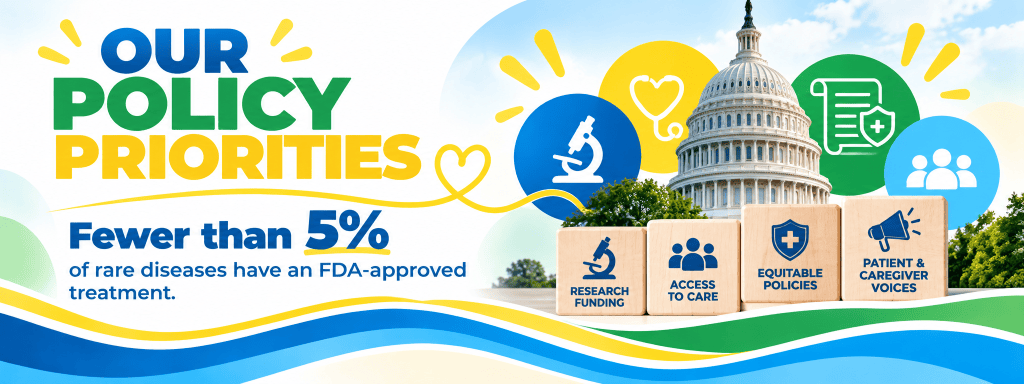
Despite scientific progress, fewer than 5% of rare diseases have an FDA-approved treatment. Families continue to face delayed diagnoses, limited treatment options, and overwhelming financial hardships. By uniting patients, caregivers, healthcare professionals, policymakers, researchers, and innovators, we can create a more equitable family-centered healthcare system.
Our Policy Recommendations
On February 3, 2026, Congress passed a package of healthcare policies that includes two landmark bills for the rare disease community and longstanding priorities raised during Rare Disease Week on Capitol Hill and Rare Across America.
- The Give Kids a Chance Act reauthorizes the Rare Pediatric Disease Priority Review Voucher (PRV) Program for five years. Its reauthorization means the program can continue catalyzing pediatric therapy development, unleashing clinical trials and investments that were on hold since the program’s lapse.
- The Accelerating Kids Access to Care Act reduces administrative barriers in Medicaid so that children with rare diseases can receive specialized care across state lines.
The package included other important policies that many in our rare disease community have advocated for. You can read more here.
Join the Rare Disease Congressional Caucus
The Rare Disease Congressional Caucus is a bipartisan group dedicated to championing the needs of the rare disease community. The Caucus:
- Fosters awareness and understanding on Capitol Hill
- Shapes legislation to address barriers to research, development, and access
- Ensures a permanent voice for rare disease patients and families in Washington
Medicaid Expansion
Expanding Medicaid coverage can transform outcomes for families by:
- Increasing access to essential care
- Reducing emergency room costs for the uninsured
- Creating new healthcare jobs and boosting local economies
- Narrowing the health coverage gap for vulnerable communities
Every person deserves access to affordable healthcare—regardless of income, geography, or diagnosis.
The RAISE Act
The RAISE (Renewing Alabama’s Investment in Student Excellence) Act was signed into law on May 5, 2025, marking a major win for all Alabama students. Students with additional needs require more resources. The RAISE Act modernizes Alabama’s 30-year-old school funding formula by creating a hybrid model in which districts receive additional funding based on the needs of the students on top of their regular funding from the existing Foundation Program. There are also accountability measures to ensure all RAISE Act funds are spent on the students who generate them. RAISE went into effect on June 1, 2025, and districts will receive RAISE funds starting in the 2025–2026 school year. Read the full bill here.
The National Economic Burden of Rare Disease Study
In 2019, the EveryLife Foundation for Rare Diseases conducted the most comprehensive study to date, estimating the total economic burden of rare diseases in the U.S. at nearly $1 trillion across 379 conditions.
Key findings revealed:
- Enormous direct medical costs
- Significant indirect costs (lost productivity, caregiving demands)
- An urgent need for increased federal funding in research and treatment development
Federal investment is crucial to mitigating this economic burden and promoting health equity for families affected by rare diseases nationwide.
Take Action
Your voice makes a difference. Join Our Advocacy Network to stay informed, take action, and amplify the voices of rare disease families and professionals. Contact Your Representatives to urge them to support rare disease legislation.
Source: Cover Alabama. www.coveralabama.org | EveryLife Foundation for Rare Diseases. www.everylifefoundation.org

